
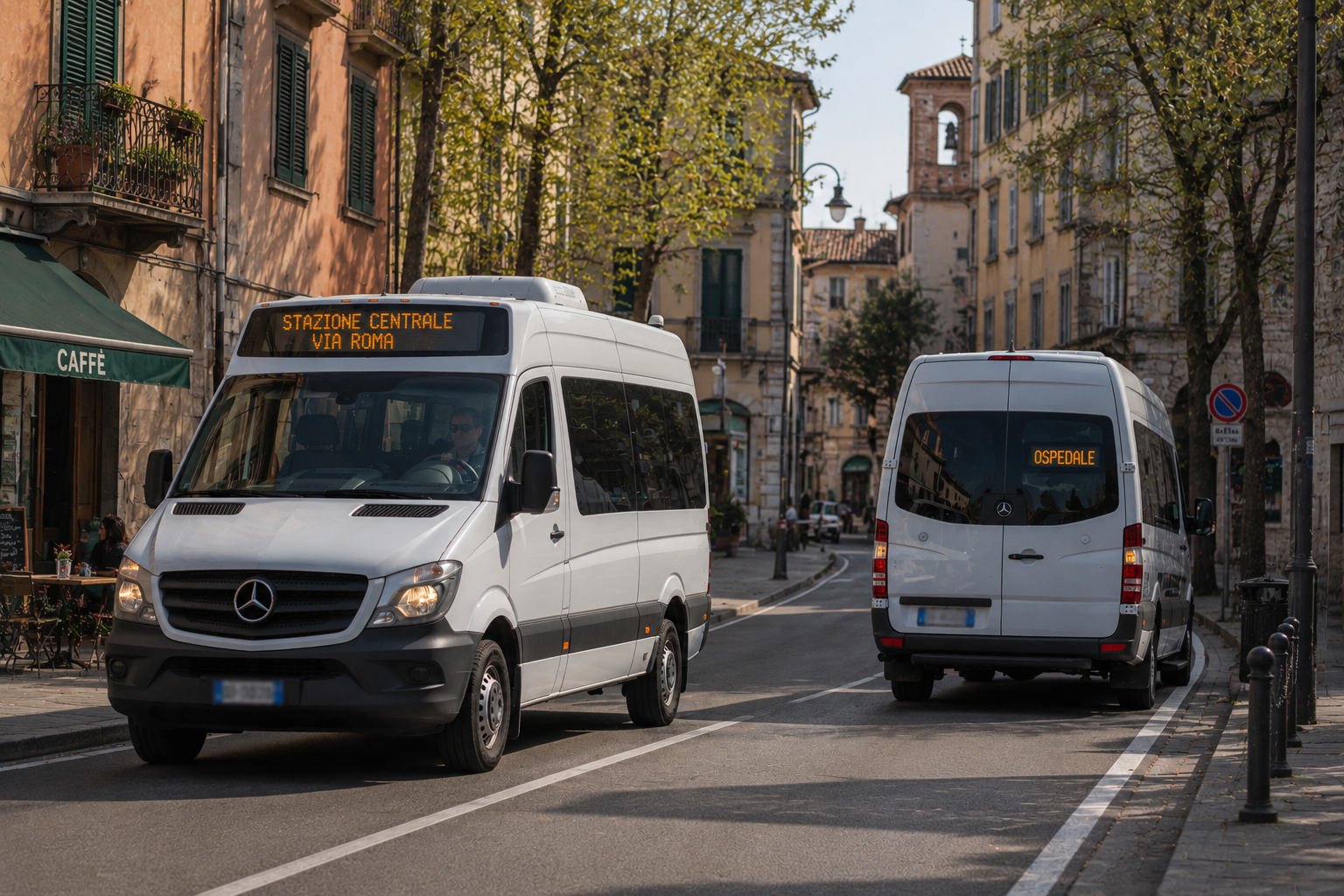
Designing Subzones: Smarter Coverage Through Operational Partitioning

When a demand-responsive transport (DRT) service grows beyond a small, uniform area, it eventually runs into the same problem: treating an entire city or region as one continuous space stops working. A surge of requests in one neighborhood can pull every available vehicle away from the rest of the network, leaving other areas underserved just when they need coverage most. One of the most effective ways to solve this is also one of the simplest in concept: splitting the service area into operational subzones.
Why Subzones Matter
Without subzones, a single high-density pocket of demand can monopolize a fleet. A concert letting out downtown, a shift change near an industrial park, or simply a busy Friday evening in the city center can absorb every vehicle in the system, while requests in quieter parts of town go unanswered or wait far longer than they should.
Subzoning addresses this by creating what can be thought of as demand islands: sectors with their own dedicated vehicles, sized and shaped around the specific pattern of demand in that part of the territory. Zones can operate independently, or interconnect at defined transfer points, depending on the underlying urban structure and how people actually move between areas. Either way, the goal is the same: reduce unnecessary inter-zonal detours and avoid the "empty return" problem that affects many shared, on-demand systems, where a vehicle drives a long way to serve one request and then returns empty instead of picking up its next passenger nearby.
The benefits show up on both sides of the service. Passengers get faster response times and more consistent, predictable access, regardless of which part of the territory they're in. Operators get simpler dispatching and more stable KPIs — wait time and ride duration stop swinging wildly based on where demand happens to spike on a given day.
Configuring Subzones
Shotl's platform supports dynamic configuration of zones and the movements allowed between them, which means subzones aren't a one-time design decision made at launch and then left untouched. They can be adjusted seasonally, expanded or contracted around a special event, or fine-tuned as real usage patterns become clearer over the life of the service.
In practice, that flexibility shows up in a few common patterns:
- Dividing a city by neighborhoods that each have their own activity hub, a town center, a transit station, a shopping district, with a subzone built around it.
- Creating dedicated mobility corridors for specific land uses, such as industrial areas, commercial districts, or largely residential neighborhoods, each with different demand rhythms throughout the day.
- Assigning vehicles to different, sometimes overlapping zones depending on the time of day, so the same fleet can serve a commuter-heavy corridor in the morning and a different, leisure-oriented zone in the evening.
Each subzone can carry its own service windows, vehicle types, pricing rules, or access conditions, giving local operators and public transport authorities a genuinely flexible tool for shaping the service around local governance needs, rather than forcing a single configuration onto an entire territory.
Complementing Fixed Transit
Subzoning also plays a role in a less obvious but equally important problem: making sure on-demand transport complements the fixed-route network instead of quietly competing with it. By defining certain areas as DRT-only territory, or limiting specific origin-destination pairs along corridors already well served by high-frequency bus or rail lines, the platform can steer passengers toward whichever option is actually the more efficient choice for their trip.
That distinction matters for the long-term health of a transit system. On-demand transport is at its most valuable when it's covering the gaps a fixed network can't reach efficiently — low-density areas, off-peak hours, first-and-last-mile connections — rather than pulling riders away from routes that are already working well. Subzoning gives operators a concrete way to draw that line explicitly, turning DRT into a precision tool inside a wider transit ecosystem instead of an unplanned substitute for it.
Operational Gains
Beyond service quality, subzoning brings clear operational advantages to fleet management. By constraining vehicle movements to predefined radii or corridors, operators typically see:
- Lower fuel consumption, since vehicles cover shorter, more predictable distances between trips.
- Easier driver scheduling, built around known zones and shift patterns rather than an unpredictable, citywide free-for-all.
- Greater route predictability, which makes both planning and communicating accurate ETAs to passengers considerably easier.
Subzoning also supports better load balancing across the fleet as a whole, helping ensure no single vehicle is left overburdened while another sits underused for long stretches of the day.
Structure, Not Fragmentation
Dividing a service area doesn't mean fragmenting the service. Done well, subzoning brings structure to a level of complexity that a single, undivided zone simply can't handle gracefully at scale — unlocking higher performance, a more consistent passenger experience, and more informed decision-making for the operators and authorities running the service.
As DRT deployments continue to grow in size and ambition, subzoning is likely to become less of an advanced configuration option and more of a default starting point for any territory beyond a certain size or complexity.
Interested in configuring a multi-zone, on-demand service for your city or region? Get in touch with our team at hello@shotl.com to explore what's possible.
Popular posts

26.02.25
Baix Empordà's Clic.cat Service
Clic.cat, an on-demand public transport service in Baix Empordà since November 2024, enhances connectivity between municipalities with limited options, using an app for real-time booking and tracking, and promoting sustainable mobility. This service, o
Sílvia Coronado
27.10.25
Shotl at Smart City Expo 2025
Shotl will attend Smart City Expo World Congress 2025 in Barcelona to connect with mobility leaders, share insights on demand-responsive transport, and explore new collaborations for smarter, more sustainable urban mobility.
Rocío Goldín

23.07.25